50 Anos de Abril: questões ambientais, sociais e territoriais

Por: Mónica Truninger

Este é o meu último post como coordenadora do GI SHIFT. Ao longo destes cinco anos, tive o privilégio de organizar as atividades do GI, contando, numa primeira fase, com a colaboração da Olivia Bina e do João Graça, e, numa segunda e última fase, do João Mourato e João Guerra. De forma a celebrar a atividade deste grupo enérgico, dinâmico e especialista em questões ambientais, sociais e territoriais, aproveito este momento  para realçar neste texto uma obra coletiva do SHIFT, que esteve em preparação ao longo de 2024 e que está prestes a chegar às livrarias. Trata-se da obra 50 Anos de Abril: Questões Ambientais, Sociais e Territoriais, da Imprensa de Ciências Sociais. Esta obra reúne um conjunto de capítulos escritos por vários investigadores do SHIFT, refletindo o trabalho desenvolvido pelo grupo enquadrado no contexto das comemorações dos 50 anos do 25 de Abril de 1974. Este marco histórico marcou a transição para a democracia em Portugal e a libertação de um regime autoritário. A Revolução dos Cravos e, a seguir a Constituição de 1976, permitiu a emergência de um novo regime democrático baseado nos princípios de liberdade, igualdade e justiça, consagrando direitos fundamentais, incluindo o direito ao ambiente e à qualidade de vida. Desde então, o país tem vivido transformações profundas em diversas áreas, mas também tem enfrentado desafios significativos, em particular nas últimas décadas, nomeadamente em relação ao ambiente, sociedade e território. 

Passadas cinco décadas, considerámos pertinente fazer uma análise crítica e reflexiva das principais transformações resultantes da instauração e consolidação da democracia: quais as expectativas cumpridas, quais as mudanças realizadas, mas também quais as promessas que ficaram por cumprir e até os retrocessos que acabaram por ocorrer. O foco dessa análise recaiu sobre as temáticas do grupo de investigação SHIFT: Ambiente, Território e Sociedade, em particular sobre as dinâmicas subjacentes aos desafios socioecológicos e territoriais da sociedade portuguesa, enquadrada não só na escala europeia, mas também na escala global. Será que o espírito de Abril se cumpriu, consolidando a transição para uma sociedade mais justa, resiliente e sustentável? E, tomando a Constituição como mote, será que foram construídos territórios mais ‘justos’ e ambientes mais ‘livres’ de diversas formas de poluição? E que capital de participação cidadã foi sendo acumulado ao longo destes 50 anos? Qual tem sido o contributo das organizações formais e informais de cidadãos para a construção de um país mais coeso, participativo e ‘fraterno’, em matéria de ambiente e território?

Tendo como mote os valores e os princípios que o 25 de abril de 1974 trouxe, e que a Constituição de 1976 consagrou, os contributos dos membros do grupo de investigação SHIFT, incluindo investigadores integrados e doutorandos, foram enquadrados por dois eixos de análise. Por um lado, os textos apresentam uma breve contextualização e trajetória históricas da temática em apreço nos últimos 50 anos, salientando os principais marcos e pontos de viragem. Por outro lado, os autores questionam até que ponto esta trajetória foi cumprida ou descontinuada, afastando-se até do espírito de Abril e fragilizando, assim, a própria democracia. 

A cover of a book

Description automatically generated

Figura 1 – Capa do livro 50 Anos de Abril – Questões ambientais, sociais e territoriais (ICS, no prelo). 

O livro está dividido em três partes: questões ambientais, questões sociais e questões territoriais, com capítulos interligados que refletem sobre as conquistas e os desafios dos últimos 50 anos. A primeira parte, dedicada às questões ambientais, inicia-se com o capítulo de João Guerra, Luísa Schmidt e David Travassos, intitulado “Áreas Protegidas – trajetórias da conservação da natureza em Portugal”. Os autores analisam os avanços e retrocessos na política de conservação, destacando a falta de recursos para gestão e fiscalização. No capítulo seguinte, “Energia solar descentralizada: 50 anos de políticas públicas”, Sofia Ribeiro analisa os desafios energéticos em Portugal, desde a eletrificação do território após a Revolução até à promoção das energias renováveis nas últimas décadas. Complementando essa análise, Vera Ferreira, em “A energia comunitária em construção – um caso de democracia em Portugal?”, explora o papel das comunidades de energia renovável como ferramentas de participação democrática e transição energética. Por fim, Joana Sá Couto, no capítulo “A tua política é o trabalho […] O teu único jogo deve ser a pesca: o trabalho na pesca desde o Estado Novo à emergência climática”, reflete sobre as crises do setor piscatório, conectando-as às escolhas políticas e ao impacto das mudanças climáticas.

A segunda parte do livro foca-se nas questões sociais. Ricardo Moreira, em “O Estado Social que a Constituição abriu e as sementes do Estado Ambiental que ainda esconde”, discute como a Revolução impulsionou o Estado Social em Portugal, destacando os avanços em direitos sociais e as limitações na integração de políticas ambientais. Simone Tulumello e Luisa Rossini, no capítulo “A paz, o pão, …, saúde educação: a habitação, a grande ausência do Estado social democrático”, analisam as políticas habitacionais desde 1974, enfatizando as tensões entre as promessas da Revolução e os problemas habitacionais que persistem atualmente. Ana Delicado e Jussara Rowland, em “50 anos de construção de uma democracia participativa em matérias ambientais”, exploram a evolução da participação cidadã em questões ambientais, desde mobilizações espontâneas até a institucionalização de audiências públicas e o papel das ONG de ambiente. Por sua vez, Roberto Falanga, José Ribeiro e João Moniz, no capítulo “Cidadania e participação nos últimos 50 anos em Portugal: a consolidação democrática entre urnas e ruas”, examinam práticas emergentes de diálogo entre cidadãos e instituições, como o Serviço de Apoio Ambulatório Local (SAAL) e os orçamentos participativos.

Na terceira parte, dedicada às questões territoriais, João Mourato, Inês Gusman e André Pereira, em “50 anos de (in)definição regional: convergências e conflitos de governança territorial em Portugal”, analisam a complexidade da governança regional, destacando os paradoxos e conflitos na organização territorial após o 25 de Abril. Kaya Schwemmlein, no capítulo “Variadas crises do sistema agrícola alentejano”, reflete sobre a evolução dos sistemas agrícolas no Alentejo, abordando questões relacionadas com o uso da terra, posse e sustentabilidade. Encerrando o volume, Rosário Oliveira, em “Alimentar as cidades de modo sustentável e saudável é preciso: das hortas urbanas ao sistema alimentar metropolitano”, descreve a transformação das hortas urbanas espontâneas em sistemas alimentares metropolitanos, propondo estratégias para o planeamento alimentar que sejam simultaneamente sustentáveis e saudáveis.

Esta obra apresenta, assim, um cenário misto, composto por avanços e desafios. Se, por um lado, foram alcançados progressos significativos em setores como a educação, a saúde, a segurança social, o abastecimento de água e o saneamento, a legislação sobre ambiente e natureza, o desenvolvimento da rede viária, a democratização das instituições e o aumento da participação cívica; por outro lado, persistem muitas questões por resolver. Entre estas, destacam-se-se as desigualdades sociais e socioterritoriais, os avanços e recuos nos debates sobre a regionalização, o difícil acesso à habitação, a gestão ineficiente da conservação da natureza, as limitações na adoção das energias renováveis, a crise no setor das pescas e os efeitos nocivos da agricultura intensiva para o ambiente e para a saúde humana. Todos estes desafios representam obstáculos à implementação de transições justas, especialmente face aos impactos crescentes das alterações climáticas no nosso país. 

Numa época marcada pelas comemorações dos 50 anos da Revolução, o livro do GI SHIFT oferece, assim, uma reflexão crítica sobre os avanços e retrocessos das últimas cinco décadas, propondo caminhos para uma sociedade mais justa, sustentável e democrática, em consonância com os ideais do 25 de Abril. 
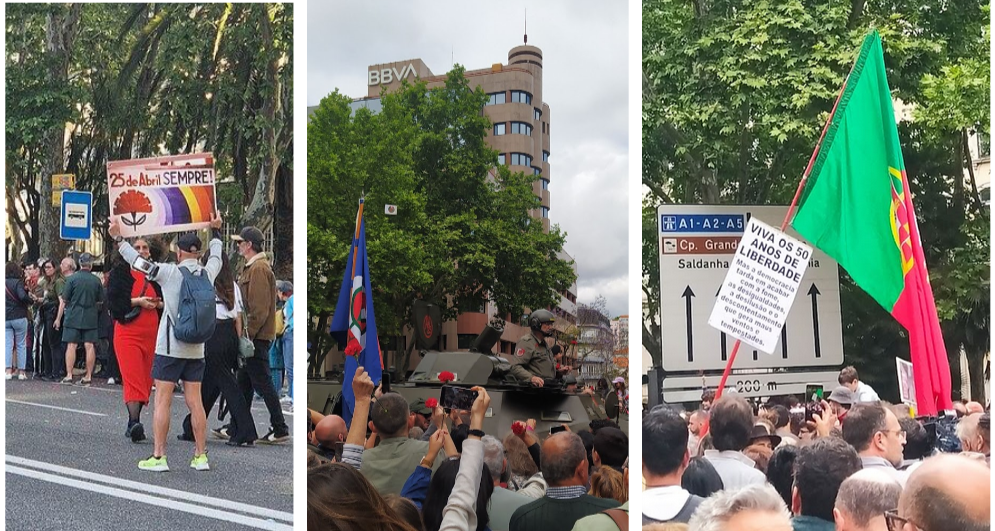
Figura 2,3,4: Desfile comemorativo dos 50 anos do 25 de Abril de 1974 (Avenida da Liberdade, Lisboa, Portugal a 25 de Abril de 2024)Fonte: figuras 3 e 4 fotos de Luisa Rossini; figura 2 RitaFMatos (https://commons.m.wikimedia.org/wiki/File:25_de_Abril_de_2024_08.jpg).

Mónica Truninger é socióloga e coordenadora (em final de mandato) do SHIFT: Grupo de Investigação Ambiente, Território e Sociedade do Instituto de Ciências Sociais da Universidade de Lisboa. monica.truninger@ics.ulisboa.pt

About songlines and relational approaches in (sustainability) sciences and education

Por: Antje Disterheft

I learned about songlines during my PhD, when I was eager to get to know participatory methods that would take people to the “depths of things” and provide “real participation” – that’s when I came across Dragon Dreaming. Fascinated by its holistic approach and its three principles – personal empowerment, community building and service to the Earth – I took several courses to learn more about it, and thereby I also learned a bit about Aborigines’ philosophies and worldviews, an important inspiration in Dragon Dreaming.

About songlines

Margo Ngawa Neale, adjunct professor at the Australian National University’s Centre for Indigenous History and senior manager at the National Museum of Australia, describes songlines as libraries that store knowledge critical to survival: these songlines, also called dreaming tracks, are sacred routes in Aboriginal culture, passed down through generations. They represent pathways across the land, guiding people physically and spiritually along distant walks and helping them find, for example, landmarks and water sources. As Aboriginal people walk these paths, they sing the land into being, reinforcing their deep relationship with it. The songs carry vital information from ancient narratives shared among different language groups, facilitating cross-cultural understanding and a perception of the land not just as a resource but as a living entity with which humans and other-than-humans are deeply intertwined.

I was thrilled to discover an exhibition on Songlines at the Musée du Quai Branly in Paris during a family trip last year. The project behind the exhibition was started by Aboriginal elders, aiming to preserve the stories of the Seven Sisters for future generations and to raise awareness of songlines more broadly. Walking through the artworks, I felt a glimpse of the cultural richness of one of the oldest Indigenous cultures—dating back approximately 60 000 years ago—and their profound connection to the more-than-human world (Figure 1).

Figure 1: Impression of the exhibition Songlines, Musée du Quai Branly Jaques Chirac, Paris (Photographs and collage by author)

The concept of songlines stayed with me and resurfaced as I explored relational approaches in sustainability research and education—a growing area of interest among scholars. I have highlighted just a few sources to introduce some key ideas being discussed in this field, and invite you to reflect on how these relational approaches might connect to the Aboriginal songlines.

Is there a relational turn in sustainability science?

This question was asked in an article by Simon West and colleagues in 2020, who emphasize relational approaches as being more holistic and dynamic analyses of human-nature connectedness. They hold the potential to open new domains and approaches for sustainability interventions that nurture relationships in place and practice. In the same year, Zack Walsh and colleagues called for action for sustainability researchers to co-develop a research agenda for advancing this relational paradigm within sustainability research, practice, and education.

Why a relational paradigm?

The emergence of a relational paradigm stems from the need to address shortcomings in previous sustainability science approaches that have mainly focused on impact reduction and resource optimisation through technology advancements as the main road to change. These approaches have fostered dualistic rather than relational understandings by addressing certain elements of the system without addressing the intrinsic relations between them. While sustainability science often emphasizes the interaction between system elements, the relational approach emphasises continually unfolding processes and relations among entities. Similar terms and concepts, such as the ecological paradigm or systems approach, metamodernism, constructive postmodernism, and new materialism, exist both within and outside sustainability-related discourses.

Walking together in a world of many worlds”

This is the subtitle of the latest publication of West et al. (2024) who have further systematized relational approaches and mapped their overlaps and differences, organized in five intersecting areas: (i) Indigenous-kinship relationalities, (ii) systemic-analytical, (iii) posthumanist-performative, (iv) structural-metabolic, and (v) Latin American-postdevelopment (Figure 2). The authors conclude that the diversity of these relationalities “gives rise to practices of transformations as ‘walking together in a world of many worlds’ and support intercultural dialogue on sustainability transformations”.

A diagram of relationships between individuals

Description automatically generated

Figure 2: Relational approaches to sustainability transformations in sustainability science (West et al. 2024, article under open access and Creative Commons CC BY license).

What about a relational turn in (higher) education?

Vivienne Bozalek, Michalinos Zembylas and Joan Tronto published an inspiring book about Posthuman and Political Care Ethics for Reconfiguring Higher Education Pedagogies that is based on relational ethics. The contributions to this book consider the various ways in which posthuman and care ethics might open more fruitful ways of reconsidering the ways in which higher education pedagogies are enacted and how they might be differently perceived in the current circumstances of educators and researchers teaching in universities.

Canadian sustainability educator Elisabeth Lange argues that relationality demands an ethical, ontological, and epistemological transformation in the ways we learn and teach. She argues that relational values, present in living systems theory and indigenous philosophies, can “reframe our understandings of transformative education, particularly toward socially just and regenerative cultures, completing the work of unfinished justice and climate movements.”

Developing “songlines” for transformative research and education?

While relational discourses may seem abstract and theoretical, they hold significant practical potential. I propose using songlines as a metaphor to open new pathways for fostering connections with places and all forms of life.

Songlines can serve as a powerful educational tool, where young people learn about geography, ecology, and culture through direct engagement with the land. In a similar way, relational sustainability in education promotes experiential learning, helping students understand the intricate relationships between natural systems, human societies, and the broader environment.

Songlines represent a form of living knowledge, passed down through generations, offering wisdom on how to care for the land. Relational sustainability also embraces multiple ways of knowing, encouraging us to draw from diverse disciplines and cultural traditions, including Indigenous wisdom, to deepen our understanding of how to coexist sustainably with the natural world.

“If you stay connected, you will stay knowledgeable.” Margo Ngawa Neale about songlines


Antje Disterheft is an inter- and transdisciplinary researcher in the fields of sustainability transformation and education. She joined ICS as a team member of the Shared Green Deal. Central to her investigation are transformative processes that question the status quo and challenge current societal paradigms of knowledge production and learning.

A CLAN for Human-Animal Studies? Opportunities and challenges of establishing the field – Part 3 

By: Verónica Policarpo

**A versão portuguesa dos 3 posts pode ser consultada aqui.

This is the last post of a series of three in which I proposed myself to reflect upon the main opportunities and challenges implied in the establishment of the field of Human-Animal Studies (HAS) in Portugal, and the role of the HAS-Hub in that process. In the first part, I recollected the strengths of international networks and funding. In the second part, I dived into the powers of connecting in our own mother tongue. Finally, in this third and last post, I will shortly discuss the major threats that, from my point of view, the HAS-Hub may face in the near future, as well as the emerging opportunities.

Continuar a ler

A CLAN for Human-Animal Studies? Opportunities and challenges of establishing the field in Portugal – Part 2

Por: Verónica Policarpo

**A versão portuguesa dos 3 posts pode ser consultada aqui.

For the last four years, the Human-Animal Studies Hub (hereafter, HAS-Hub) has brought together scholars from different disciplinary backgrounds and institutions, under a common interest: the critical appraisal of the multiple and systemic ways through which humans have exploited nonhuman animals, and an ethical commitment to contribute to diminish their suffering. In this post, I resume the reflection initiated here about this process. In the first part, I leaned over the rising strengths of international networks and collaborations, as well as the angular role of funding to foster research, training and dissemination. In this second part, I wish to highlight – and honour – the power of connecting and working in our mother tongue. Building a HAS network that speaks, not only but also, in Portuguese is a major mission of the HAS-Hub. I will try to show the role of post-graduate education in this process, in particular the post-graduate course Animais e Sociedade. This reflection will not end today, though. In a future third and last part, I will highlight what are, from my point of view, the major threats that the HAS-Hub faces in the near future, as well as emerging opportunities.

Continuar a ler

A CLAN for Human-Animal Studies? Opportunities and challenges of establishing the field in Portugal – Part 1

By: Verónica Policarpo

**A versão portuguesa dos 3 posts pode ser consultada aqui.

Three sociologists meet at a conference in Athens

In September 2017, the congress of the European Sociological Association was held in legendary Athens. It was a very hot day, and as it happens to me often, my presentation was on the very last day of the conference, on the very last time slot, late in the day. Feeling all the tiredness that comes after a long week of one of these big conferences, I headed to the venue early in the morning, after a sleepless night. I had browsed the conference program several times, looking for presentations that had the word “animal”, or any other related, in the title or abstract. I had found only three. One of them was exactly on the very same panel, and the very same day, in which I was going to present my own work. Moreover, it was about a topic very dear to me: death and mourning for a companion animal.

Continuar a ler

Multispecies organizing: “de-anthropocentering” management practices in the city

By: Leticia Fantinel

Organizations are omnipresent in our lives. We are born in hospitals, we study in schools, we work for companies, and when we die, we go to cemeteries. Organizations represent one of the main instruments for mediating our relationships with other human beings, with our cities, or even with the environment and other animals. Organizations make possible animal exploitation in complex food systems and laboratory experimentation. Organizations coordinate human and non-human work in assisted therapies, as well as in aquariums and zoos. Furthermore, it is through organizations that public management intermediates our relationships with multiple non-human populations in our cities. The latter was the subject of a project we developed in Brazil.

Continuar a ler

De qué hablamos cuando hablamos de Sociología Ambiental

Por: Antonio Aledo

Estoy realizando una estancia académica en el Instituto de Ciencias Sociales de la Universidad de Lisboa en el equipo de investigación liderado por la Dra. Luisa Schmidt y con el apoyo de la Dra. Carla Gomes. Esta estancia está financiada por el Ministerio de Universidades del Gobierno de España dentro del Programa de Estancias de Movilidad de Investigadores en Centros Extranjeros. La preparación de un manual de sociología ambiental es uno de los objetivos principales de esta estancia. En los próximos párrafos resumo los principios fundamentales sobre los que se ha construido la sociología ambiental, que van a dirigir los contenidos de este manual.

Continuar a ler

BIODIVERSIDADE 2030. NOVA AGENDA PARA A CONSERVAÇÃO DA BIODIVERSIDADE EM CONTEXTO DE ALTERAÇÕES CLIMÁTICAS EM PORTUGAL

Por: Rosário Oliveira e João Mourato

A biodiversidade é fundamental, pois dela depende a regulação de processos essenciais à vida como a composição química da atmosfera, do solo, da água, e a capacidade de produção agrícola e florestal. A sua perda afeta inevitavelmente a espécie humana, pelo que a sua conservação é crucial também para a nossa sobrevivência.

Contudo, as estratégias de conservação internacionais, europeias e nacionais não têm sido capazes de travar e inverter a perda alarmante de biodiversidade nas últimas décadas, sendo, assim, necessário ir além das tradicionais medidas de conservação (ex. gestão de áreas protegidas, proteção de espécies ameaçadas, controlo de espécies invasoras).

Continuar a ler

A Era das Omnipresenças

Por: João Baptista

É capaz de cuidar de algo que não vê? Preocupar-se com o que não consegue tocar, ainda que esteja ao seu lado? Abdicar de consumir o que gosta por aquilo que não consegue sentir? Mudar as suas rotinas em prol de algo que está para além do seu conhecimento, mas que encontra em todos os sítios onde vai?

Este é, talvez, um dos maiores desafios que a humanidade enfrenta hoje. O de acordarmos, todos os dias, junto a algo que não sentimos, não vemos, não conseguimos tocar, mas pelo qual somos responsáveis. Timothy Morton deu-lhes o nome de hiperobjetos. A ideia de hiperobjectos é genial. Mas a designação é frustrante. O prefixo “hiper-” e a palavra “objeto” desviam-nos da condição espiritual que as entidades globais a que a conjugação se refere têm. O termo “hiperobjecto” atribui-lhes um carácter explícito, tangível. Materializa essas entidades. Dá-lhes um significado mais concreto do que elas requerem. Daí preferir chamar-lhes omnipresenças. Bem-vindo à Era das Omnipresenças.

Continuar a ler

Lisboa verde oriental – entre parques, hortas e corredores verdes

Por: David Travassos

Foto 1 – A zona oriental de Lisboa oferece uma coleção diversificada, e até surpreendente, de lugares e áreas verdes (exemplo do Parque do Vale do Silêncio). Fotografia do autor.

A zona oriental de Lisboa oferece uma colecção diversificada, e até surpreendente, de lugares e áreas verdes propícias ao lazer e contacto com a natureza em espaço urbano. São múltiplos ambientes, alguns ainda pouco conhecidos pela maioria dos lisboetas, incluindo lugares marcados pelas memórias do passado rural que caracterizou este lado da cidade até meados do século XX. Este território tem vindo a beneficiar da abertura de uma série de novos espaços verdes, parques hortícolas, ciclovias e percursos pedonais, incluindo a requalificação ambiental e paisagística de áreas degradadas. Somam-se ainda novos quiosques e esplanadas, parques infantis, equipamentos e circuitos de manutenção, que possibilitam um melhor usufruto destas áreas.

Continuar a ler