50 Anos de Abril: questões ambientais, sociais e territoriais

Por: Mónica Truninger

Este é o meu último post como coordenadora do GI SHIFT. Ao longo destes cinco anos, tive o privilégio de organizar as atividades do GI, contando, numa primeira fase, com a colaboração da Olivia Bina e do João Graça, e, numa segunda e última fase, do João Mourato e João Guerra. De forma a celebrar a atividade deste grupo enérgico, dinâmico e especialista em questões ambientais, sociais e territoriais, aproveito este momento  para realçar neste texto uma obra coletiva do SHIFT, que esteve em preparação ao longo de 2024 e que está prestes a chegar às livrarias. Trata-se da obra 50 Anos de Abril: Questões Ambientais, Sociais e Territoriais, da Imprensa de Ciências Sociais. Esta obra reúne um conjunto de capítulos escritos por vários investigadores do SHIFT, refletindo o trabalho desenvolvido pelo grupo enquadrado no contexto das comemorações dos 50 anos do 25 de Abril de 1974. Este marco histórico marcou a transição para a democracia em Portugal e a libertação de um regime autoritário. A Revolução dos Cravos e, a seguir a Constituição de 1976, permitiu a emergência de um novo regime democrático baseado nos princípios de liberdade, igualdade e justiça, consagrando direitos fundamentais, incluindo o direito ao ambiente e à qualidade de vida. Desde então, o país tem vivido transformações profundas em diversas áreas, mas também tem enfrentado desafios significativos, em particular nas últimas décadas, nomeadamente em relação ao ambiente, sociedade e território. 

Passadas cinco décadas, considerámos pertinente fazer uma análise crítica e reflexiva das principais transformações resultantes da instauração e consolidação da democracia: quais as expectativas cumpridas, quais as mudanças realizadas, mas também quais as promessas que ficaram por cumprir e até os retrocessos que acabaram por ocorrer. O foco dessa análise recaiu sobre as temáticas do grupo de investigação SHIFT: Ambiente, Território e Sociedade, em particular sobre as dinâmicas subjacentes aos desafios socioecológicos e territoriais da sociedade portuguesa, enquadrada não só na escala europeia, mas também na escala global. Será que o espírito de Abril se cumpriu, consolidando a transição para uma sociedade mais justa, resiliente e sustentável? E, tomando a Constituição como mote, será que foram construídos territórios mais ‘justos’ e ambientes mais ‘livres’ de diversas formas de poluição? E que capital de participação cidadã foi sendo acumulado ao longo destes 50 anos? Qual tem sido o contributo das organizações formais e informais de cidadãos para a construção de um país mais coeso, participativo e ‘fraterno’, em matéria de ambiente e território?

Tendo como mote os valores e os princípios que o 25 de abril de 1974 trouxe, e que a Constituição de 1976 consagrou, os contributos dos membros do grupo de investigação SHIFT, incluindo investigadores integrados e doutorandos, foram enquadrados por dois eixos de análise. Por um lado, os textos apresentam uma breve contextualização e trajetória históricas da temática em apreço nos últimos 50 anos, salientando os principais marcos e pontos de viragem. Por outro lado, os autores questionam até que ponto esta trajetória foi cumprida ou descontinuada, afastando-se até do espírito de Abril e fragilizando, assim, a própria democracia. 

A cover of a book

Description automatically generated

Figura 1 – Capa do livro 50 Anos de Abril – Questões ambientais, sociais e territoriais (ICS, no prelo). 

O livro está dividido em três partes: questões ambientais, questões sociais e questões territoriais, com capítulos interligados que refletem sobre as conquistas e os desafios dos últimos 50 anos. A primeira parte, dedicada às questões ambientais, inicia-se com o capítulo de João Guerra, Luísa Schmidt e David Travassos, intitulado “Áreas Protegidas – trajetórias da conservação da natureza em Portugal”. Os autores analisam os avanços e retrocessos na política de conservação, destacando a falta de recursos para gestão e fiscalização. No capítulo seguinte, “Energia solar descentralizada: 50 anos de políticas públicas”, Sofia Ribeiro analisa os desafios energéticos em Portugal, desde a eletrificação do território após a Revolução até à promoção das energias renováveis nas últimas décadas. Complementando essa análise, Vera Ferreira, em “A energia comunitária em construção – um caso de democracia em Portugal?”, explora o papel das comunidades de energia renovável como ferramentas de participação democrática e transição energética. Por fim, Joana Sá Couto, no capítulo “A tua política é o trabalho […] O teu único jogo deve ser a pesca: o trabalho na pesca desde o Estado Novo à emergência climática”, reflete sobre as crises do setor piscatório, conectando-as às escolhas políticas e ao impacto das mudanças climáticas.

A segunda parte do livro foca-se nas questões sociais. Ricardo Moreira, em “O Estado Social que a Constituição abriu e as sementes do Estado Ambiental que ainda esconde”, discute como a Revolução impulsionou o Estado Social em Portugal, destacando os avanços em direitos sociais e as limitações na integração de políticas ambientais. Simone Tulumello e Luisa Rossini, no capítulo “A paz, o pão, …, saúde educação: a habitação, a grande ausência do Estado social democrático”, analisam as políticas habitacionais desde 1974, enfatizando as tensões entre as promessas da Revolução e os problemas habitacionais que persistem atualmente. Ana Delicado e Jussara Rowland, em “50 anos de construção de uma democracia participativa em matérias ambientais”, exploram a evolução da participação cidadã em questões ambientais, desde mobilizações espontâneas até a institucionalização de audiências públicas e o papel das ONG de ambiente. Por sua vez, Roberto Falanga, José Ribeiro e João Moniz, no capítulo “Cidadania e participação nos últimos 50 anos em Portugal: a consolidação democrática entre urnas e ruas”, examinam práticas emergentes de diálogo entre cidadãos e instituições, como o Serviço de Apoio Ambulatório Local (SAAL) e os orçamentos participativos.

Na terceira parte, dedicada às questões territoriais, João Mourato, Inês Gusman e André Pereira, em “50 anos de (in)definição regional: convergências e conflitos de governança territorial em Portugal”, analisam a complexidade da governança regional, destacando os paradoxos e conflitos na organização territorial após o 25 de Abril. Kaya Schwemmlein, no capítulo “Variadas crises do sistema agrícola alentejano”, reflete sobre a evolução dos sistemas agrícolas no Alentejo, abordando questões relacionadas com o uso da terra, posse e sustentabilidade. Encerrando o volume, Rosário Oliveira, em “Alimentar as cidades de modo sustentável e saudável é preciso: das hortas urbanas ao sistema alimentar metropolitano”, descreve a transformação das hortas urbanas espontâneas em sistemas alimentares metropolitanos, propondo estratégias para o planeamento alimentar que sejam simultaneamente sustentáveis e saudáveis.

Esta obra apresenta, assim, um cenário misto, composto por avanços e desafios. Se, por um lado, foram alcançados progressos significativos em setores como a educação, a saúde, a segurança social, o abastecimento de água e o saneamento, a legislação sobre ambiente e natureza, o desenvolvimento da rede viária, a democratização das instituições e o aumento da participação cívica; por outro lado, persistem muitas questões por resolver. Entre estas, destacam-se-se as desigualdades sociais e socioterritoriais, os avanços e recuos nos debates sobre a regionalização, o difícil acesso à habitação, a gestão ineficiente da conservação da natureza, as limitações na adoção das energias renováveis, a crise no setor das pescas e os efeitos nocivos da agricultura intensiva para o ambiente e para a saúde humana. Todos estes desafios representam obstáculos à implementação de transições justas, especialmente face aos impactos crescentes das alterações climáticas no nosso país. 

Numa época marcada pelas comemorações dos 50 anos da Revolução, o livro do GI SHIFT oferece, assim, uma reflexão crítica sobre os avanços e retrocessos das últimas cinco décadas, propondo caminhos para uma sociedade mais justa, sustentável e democrática, em consonância com os ideais do 25 de Abril. 
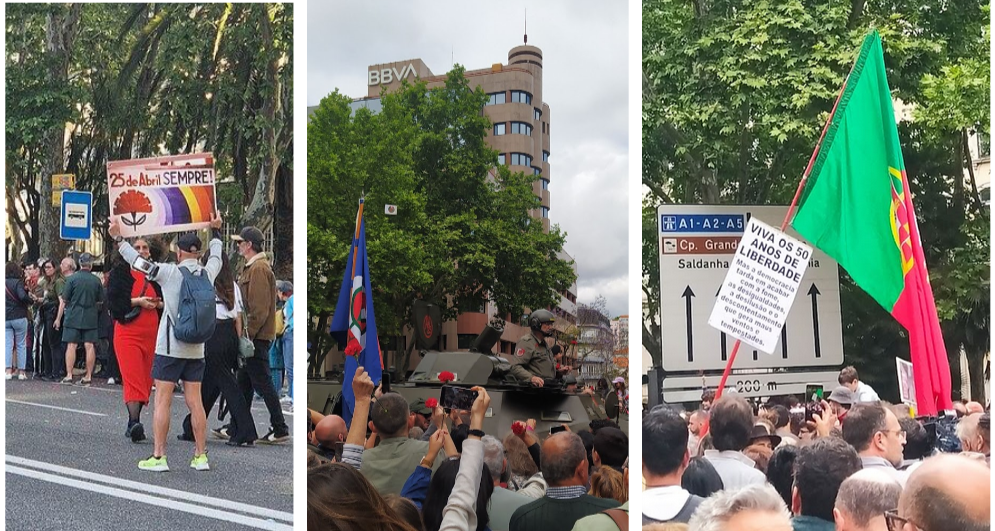
Figura 2,3,4: Desfile comemorativo dos 50 anos do 25 de Abril de 1974 (Avenida da Liberdade, Lisboa, Portugal a 25 de Abril de 2024)Fonte: figuras 3 e 4 fotos de Luisa Rossini; figura 2 RitaFMatos (https://commons.m.wikimedia.org/wiki/File:25_de_Abril_de_2024_08.jpg).

Mónica Truninger é socióloga e coordenadora (em final de mandato) do SHIFT: Grupo de Investigação Ambiente, Território e Sociedade do Instituto de Ciências Sociais da Universidade de Lisboa. monica.truninger@ics.ulisboa.pt

Emerging Urban Imaginaries and libertarian utopianism: The Case of Prospera in Honduras

Por: Lara Caldas

Imagine a city with completely privatized governance and rules. An environment where a single company unilaterally provides every urban and livability service in exchange for a subscription fee while preserving free market policies. This libertarian utopia became a reality in Honduras, indicating that emerging radical urban imaginations might not align with democracy’s ideals.

A drawing of a ship in the water

Description automatically generated

Figure 1. Photo-collage by the author, using images from: https://www.goodfon.com/city/wallpaper-zaha-hadid-s-innovation-tower-zdaniia-arkhitektura-rastiteln.html and https://www.needpix.com/photo/609300/roatan-honduras-landscape-seascape-caribbean-travel-nature (both licensed as Creative Commons)

The initial idea of a private citadel traces back to Paul Romer, a renowned economist and once the World Bank’s vice president. In the early 2000s, Romer suggested that Charter Cities (CC) could serve as a developmental solution for the Global South. The colonial regime of Hong Kong inspired him to imagine exceptional territories operating under separate, improved rules than those of a “mainland.” These new cities would have their own normative apparatus – a charter –, making them partially independent of the country in which they are located. 

The goal of a CC is to establish a special economic zone with urban dimensions. Experts would design a charter to favor foreign investment and promote economic development, covering labor laws, environmental and urban planning regulations, special tax regimes, and even the justice system. The latter is crucial, as Romer believes that countries in the Global South are socially prone to having bad rules and failing to enforce contracts. Moreover, Romer proposes suspending political-democratic rights, such as direct elections. Since experts predetermine every decision, popular participation is deemed unnecessary. Hence, Romer suggested that residents should “vote with their feet,” leaving the city if the regime proves unsatisfactory, something akin to switching banks.

The obvious consequence is reducing political rights to consumer rights. However, CCs can appeal to the political class by addressing real social demands like safety, employment, and economic growth – though through an elitist framework with a homogeneous idea of development. Against accusations of neocolonialism, Romer argues that their legitimacy lies in their exceptional nature. The proposal is not to occupy entire countries nor to create these territories by force (although Romer presents a very insufficient notion of force, one that ignores countries’ power disparities and the capacity of market actors to meddle with politics). These zones are portrayed as innovation sandboxes, small special areas for investment and governance experimentation.

In 2009, shortly after the coup d’état, Juan Orlando Hernández, President of the National Congress of Honduras, and Porfirio Lobo, then-President, invited Paul Romer to lead a Charter City project. In February 2011, the Honduran Congress passed a constitutional amendment to enable Charter Cities in Honduras, initially called Regiones Especiales de Desarrollo (REDs). In July, the governance statute for REDs was approved. According to this document, REDs were designed as special zones with broad administrative, fiscal, legal, and regulatory autonomy, provided with a transparency commission appointed and overseen by the President. In 2012, the Honduran government entered into an agreement with MGK Group (a company associated with Michael Strong, a well-known libertarian activist) to develop the first RED. This agreement was made without Romer’s knowledge or the involvement of the transparency commission, leading to Romer’s abandonment of the project.

In October, the Honduran Supreme Court declared the REDs unconstitutional, stating that the law violated Honduras’ territorial integrity, sovereignty, and independence. Shortly after, in December, Congress removed four Supreme Court judges who had voted against the REDs. The President of Congress then appointed replacements aligned with the government’s plan, a move criticized as illegal by commentators. Less than a month later, amid fierce opposition from Indigenous islander communities and without consultation or social participation, a new constitutional amendment was approved, establishing the Zonas de Empleo y Desarrollo Económico (ZEDEs).

Figure 2: The Garifuna people protesting the RED project in Tegucigalpa, 2012. Photo by: Honduras Delegation, on flickr.

Prospera is the first ZEDE in Honduras, established in 2017 by the company Prospera LLC, based in Delaware, a well-known tax haven in the United States. Its main investor was NeWay Capital, a financial group based in Washington, DC. This company is linked to the Tipolis Inc. group, led by Titus Gebel, a German economist and founder of the non-profit organization Free Private Cities. Gabel is also the author of a homonymous book that promotes private cities as a solution for those dissatisfied with the rules of nation-states. The project attracted entrepreneurs associated with neoliberal and libertarian activists, including the then-president of the Hayek Institute and prominent figures from the cryptocurrency sector. The ZEDE was implemented on indigenous lands without prior consultation (despite legal prerogatives) and faced widespread opposition.

Figure 3: Prospera is located on the island of Roatan, Honduras. (Google maps with author’s edition).

Prospera embodies many of Romer’s ideals. The new city is an autonomous zone, both financially and administratively, managed by a non-elected council. It has its own governance and justice systems, operating under rules distinct from the national legal framework. Prospera’s court functions through an app developed by an investor and advisory board member of the same company that manages the ZEDE.

Legal experts say that constitutional protections have been weakened, including guarantees of free speech, protections against forced labor, safeguards against discrimination based on gender and race, and even the right to Habeas Corpus. Land ownership rights are among the most undermined, as the regulatory decree stipulates that no precautionary measure shall be implemented to prevent or delay land expropriation. While compensation for expropriations is required, it is only provided in cases where formal ownership titles exist, something that many traditional indigenous populations lack. Luxury condominiums designed by international “starchitect” Zaha Hadid are replacing traditional fishing communities. Prospera is a new city, but more importantly, it is a normative innovation, semiautonomous from Honduras and oriented towards the interests of a transnational class of investors.Prospera falls under the Honduras-United States bilateral agreement (CAFTA-DR), which protects U.S.-origin investments. Therefore, although Honduras elected the socialist Xiomara Castro in 2022, who managed to repeal the ZEDE law, the national government cannot unilaterally terminate the agreement with NeWay Capital without facing indemnity proceedings. Additionally, ZEDEs have vested rights under the Honduran Constitution. Even with the repeal of the legislation, all concessions will remain in effect for at least 10 years. While this process is lengthy and cumbersome, Prospera remains a concrete example of corporations’ power in the South and their capacity to shape urban futures according to their interests.

Lara Caldas is a postdoc fellow in Political Science at the University of Brasilia. She is a researcher at Observatório das Metrópoles and a member of the research group Geopolitics and Urbanization. Her research interests lie in the intersection of urbanization and democracy. Contact: lara.cfsilveira@gmail.com

Venham ao Fórum da Habitação! (Post promocional-epistemológico)

Por: Marco Allegra

A equipa do projeto LOGO está a organizar o primeiro Fórum da Habitação do projeto no dia 26 de março.

Continuar a ler

Notes on co-production exercises between academia and social movements

By: Antonio Gori

«Aucun “je” dans ce qu’elle voit comme une sorte d’autobiographie impersonnelle – mais “on” et “nous” – comme si, à son tour, elle faisait le récit des jours d’avant »

(Annie Ernaux, Les Annés, 2008: 252)

My research aims to trace the history of the housing struggle movements in the city of Lisbon over the last decade. In doing so, I focus on the activities of two groups of which I have had the pleasure and honour of being a member for several years now: the Habita association and the Stop Despejos collective.

The choice to study these two organisations stems not only from the fact that they are the two main protagonists of this type of instance in the Lisbon Metropolitan Area, but also because they are the organisations I am participating in. This would have allowed me to paint a picture from a privileged position that, ethical issues aside, could give originality to my thesis and also possibly help the two organisations to improve their functioning, their actions and their self-perception.

Continuar a ler

A CLAN for Human-Animal Studies? Opportunities and challenges of establishing the field – Part 3 

By: Verónica Policarpo

**A versão portuguesa dos 3 posts pode ser consultada aqui.

This is the last post of a series of three in which I proposed myself to reflect upon the main opportunities and challenges implied in the establishment of the field of Human-Animal Studies (HAS) in Portugal, and the role of the HAS-Hub in that process. In the first part, I recollected the strengths of international networks and funding. In the second part, I dived into the powers of connecting in our own mother tongue. Finally, in this third and last post, I will shortly discuss the major threats that, from my point of view, the HAS-Hub may face in the near future, as well as the emerging opportunities.

Continuar a ler

A CLAN for Human-Animal Studies? Opportunities and challenges of establishing the field in Portugal – Part 2

Por: Verónica Policarpo

**A versão portuguesa dos 3 posts pode ser consultada aqui.

For the last four years, the Human-Animal Studies Hub (hereafter, HAS-Hub) has brought together scholars from different disciplinary backgrounds and institutions, under a common interest: the critical appraisal of the multiple and systemic ways through which humans have exploited nonhuman animals, and an ethical commitment to contribute to diminish their suffering. In this post, I resume the reflection initiated here about this process. In the first part, I leaned over the rising strengths of international networks and collaborations, as well as the angular role of funding to foster research, training and dissemination. In this second part, I wish to highlight – and honour – the power of connecting and working in our mother tongue. Building a HAS network that speaks, not only but also, in Portuguese is a major mission of the HAS-Hub. I will try to show the role of post-graduate education in this process, in particular the post-graduate course Animais e Sociedade. This reflection will not end today, though. In a future third and last part, I will highlight what are, from my point of view, the major threats that the HAS-Hub faces in the near future, as well as emerging opportunities.

Continuar a ler

A CLAN for Human-Animal Studies? Opportunities and challenges of establishing the field in Portugal – Part 1

By: Verónica Policarpo

**A versão portuguesa dos 3 posts pode ser consultada aqui.

Three sociologists meet at a conference in Athens

In September 2017, the congress of the European Sociological Association was held in legendary Athens. It was a very hot day, and as it happens to me often, my presentation was on the very last day of the conference, on the very last time slot, late in the day. Feeling all the tiredness that comes after a long week of one of these big conferences, I headed to the venue early in the morning, after a sleepless night. I had browsed the conference program several times, looking for presentations that had the word “animal”, or any other related, in the title or abstract. I had found only three. One of them was exactly on the very same panel, and the very same day, in which I was going to present my own work. Moreover, it was about a topic very dear to me: death and mourning for a companion animal.

Continuar a ler

Screening the Precarious Spaces of Home Across Europe

By: Anna Viola Sborgi

On September 19, 2022, a public screening entitled Espaços Precários da Habitação na Europa – Precarious Homes Across Europe took place at ICS-ULisboa. The screening showcased work of four emerging women filmmakers: Ayo Akingbade’s Dear Babylon (2019, United Kingdom), Leonor Teles’s Cães que Ladram aos Pássaros (2019, Portugal), Laura Kavanagh’s No Place (2019, Ireland and United Kingdom) and Margarida Leitão’s Gipsofila (Portugal, 2015). After watching the films, filmmaker Margarida Leitão and researchers Roberto Falanga and Mariana Liz joined me in an interdisciplinary conversation on cities, their inhabitants, gentrification and film. Members of the audience, which included participants in the Cinema e Ciências Sociais Summer School that was taking place at ICS-ULisboa in those very days, also asked questions and contributed to the discussion.

Continuar a ler

Co-Produção: A Inteligência Humana ao Serviço das Nossas Cidades

Por: Diogo Martins

Estamos sempre a falar em cidades mais inteligentes, com sensores, inteligência artificial, com software que irá gerir tudo ao pormenor, com tecnologia que nós, hoje, não conhecemos. Mas em que medida toda esta tecnologia traz benefícios às pessoas que habitam e frequentam as cidades? E estaremos a tirar partido da inteligência dessas pessoas para melhorar as nossas cidades?

A minha proposta é explorarmos formas de voltar às pessoas, sem deixarmos de evoluir e usar tecnologia. A co-produção é ainda pouco utilizada no nosso dia-a-dia e por isso não vemos efeitos práticos disso nas nossas cidades com a frequência que é desejável.

Continuar a ler

Metápolis: “nem tudo que é sólido se desmancha no ar”

Por: Mariano Macedo

Essas notas visam problematizar o conceito de Metápolis de forma a referenciar a discussão sobre o futuro das cidades. Coloco 4 questões para reflexão.

A primeira questão é relativa ao conceito de metápolis e porque esse conceito emerge como relevante no momento atual de nossa história.  À semelhança de metápolis, outros conceitos vêm se afirmando: cidade informacional, cidade pós-moderna, cidade pós-fordista e pós-metrópolis.      

Esses conceitos procuram identificar as tendências que estão marcando a transição da metrópole tradicional para a metápolis e visam apreender as suas características socioespaciais e conformação morfológica.

Continuar a ler