By: Ana Prades and Yolanda Lechon
On 6 May 2026, researchers, educators, students and sustainability practitioners gathered at the Institute of Social Sciences of the University of Lisbon (ICS-ULisboa) for the event “Sustainability Competences for Climate Action: From Theory to Educational Practice – The ECF4CLIM Project.” The event was organised within the framework of the Horizon 2020 project ECF4CLIM (A European Competence Framework for Low Carbon Economy and Sustainability through Education), coordinated by CIEMAT, with the participation of researchers from several European countries. Hosted in Lisbon by the research group SHIFT at ICS-ULisboa, the workshop combined presentations, practical examples from Portuguese educational institutions, participatory activities and open debate.
The workshop provided an opportunity to present the results and methodology of the European project ECF4CLIM and to reflect collectively on how education can foster transformative climate action. Educational communities increasingly need sustainability competences to strengthen their resilience and action in the face of socio-ecological crises and uncertainty.
Rethinking Sustainability Competences
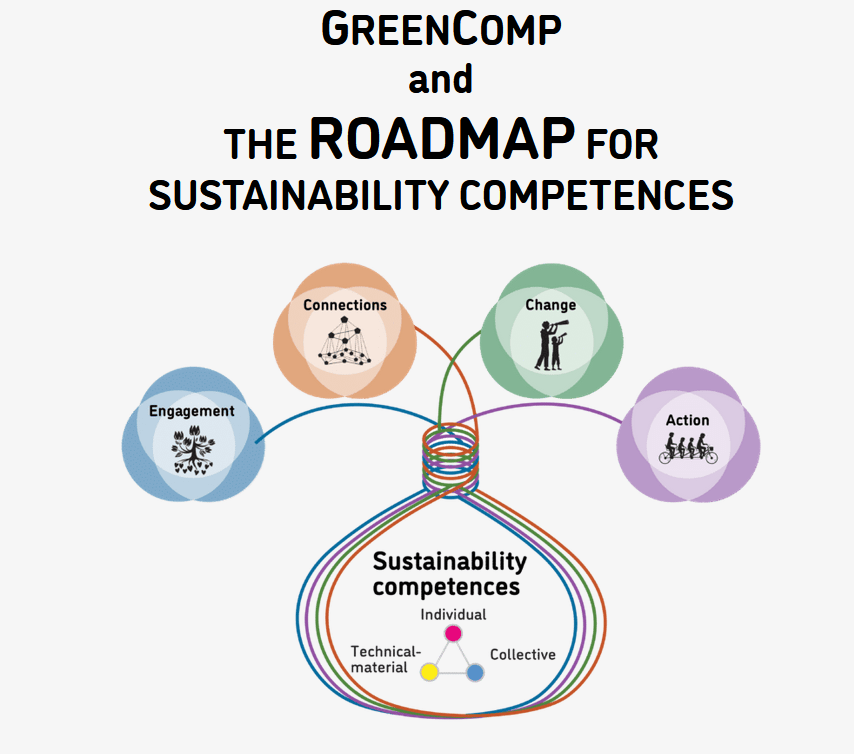
One of the central ideas discussed during the event was that sustainability competences cannot be limited to individual knowledge or behaviours alone. The ECF4CLIM project proposes a broader understanding of competences, integrating three interconnected dimensions: individual, collective and techno-material competences. This perspective expands the European Commission’s GreenComp framework by recognising the importance of organisational cultures, infrastructures, regulations and material conditions in enabling sustainable action.
During the opening presentation, the authors explained how the project was developed through an innovative participatory and transdisciplinary approach involving schools, universities and local communities. ECF4CLIM worked closely with 13 demonstration sites in Finland, Portugal, Romania and Spain to co-design, test and validate a European Competence Framework for transformative change.
The project’s methodology is based on participatory action research and citizen science. Instead of applying predefined solutions, ECF4CLIM engaged educational communities directly in identifying needs, designing interventions and evaluating results. This collaborative process involved students, teachers, administrative staff and other stakeholders working together through Sustainability Competence Teams and Committees. More than 500 participants contributed actively throughout the project.
Five Key Results of the Project
The Lisbon workshop highlighted the five main outcomes achieved by ECF4CLIM over the course of the project.
1. A New Conceptual Framework
The project developed a new conceptual understanding of sustainability competences that combines:
- Individual competences, such as knowledge, attitudes and skills;
- Collective competences, linked to organisational capacities, governance and institutional culture;
- Techno-material competences, related to infrastructures, technologies and physical environments that facilitate or constrain sustainable action.
The project demonstrated that these three spheres are deeply interconnected and mutually reinforcing. Educational transformation does not emerge from isolated individual actions but from the dynamic interaction between people, institutions and material conditions.
2. The ECF4CLIM Sustainability Competence Roadmap
Another important achievement is the ECF4CLIM Roadmap for Sustainability Competences, which adapts and expands GreenComp into a practical tool for educational contexts. The roadmap addresses four key areas: engagement, connections, change and action. It helps educational institutions understand how sustainability competences can be fostered simultaneously at the individual, collective and techno-material levels.
The roadmap has also been integrated into the MAPPA.fi digital platform, making it accessible and usable for educators interested in applying the approach in their own institutions.
3. An Innovative Participatory Hybrid Approach
A major focus of the Lisbon event was the participatory methodology developed by the project. ECF4CLIM introduced a hybrid model combining co-design, co-implementation and participatory evaluation processes within educational communities.
Participants learned how this methodology encourages schools and universities to become active agents of change rather than passive recipients of sustainability policies. According to feedback collected within the project, the process promoted a more integrated and holistic understanding of sustainability and generated positive impacts on students, teachers and staff alike.
4. A Catalogue of Replicable Interventions
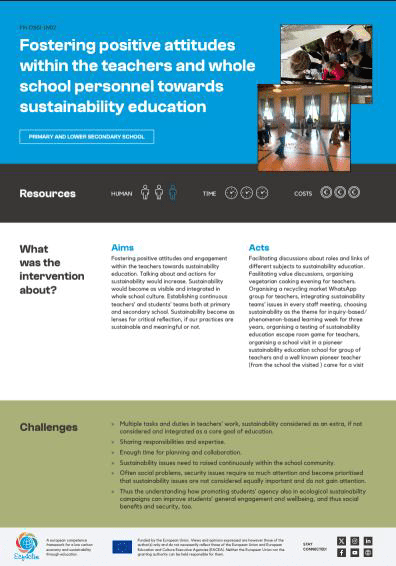
The project also produced a catalogue of sustainability interventions implemented across all the 13 demonstration sites. Initially, 159 interventions were designed, 87 selected for implementation and 64 finally carried out during the project. Among them, 22 flagship interventions were identified as particularly successful and replicable.
The interventions addressed a wide variety of sustainability challenges, including energy and water reduction, waste management, recycling activities, green spaces, awareness campaigns, escape rooms, digital tools and interdisciplinary learning activities. Many interventions also involved practical visits and student-led educational materials, helping learners engage directly with local environmental issues.
At the Lisbon workshop, practical examples from Portuguese educational institutions were presented by Marta Almeida from Instituto Superior Técnico ULisboa, illustrating how the project’s methodology can be translated into concrete educational action.
5. Digital Tools and Educational Materials
ECF4CLIM has also developed several digital tools and pedagogical resources to support active learning for sustainability. These include:
- An environmental footprint calculator designed for educational communities;
- A retrofitting toolkit for assessing building energy efficiency;
- A sustainability intervention assessment tool;
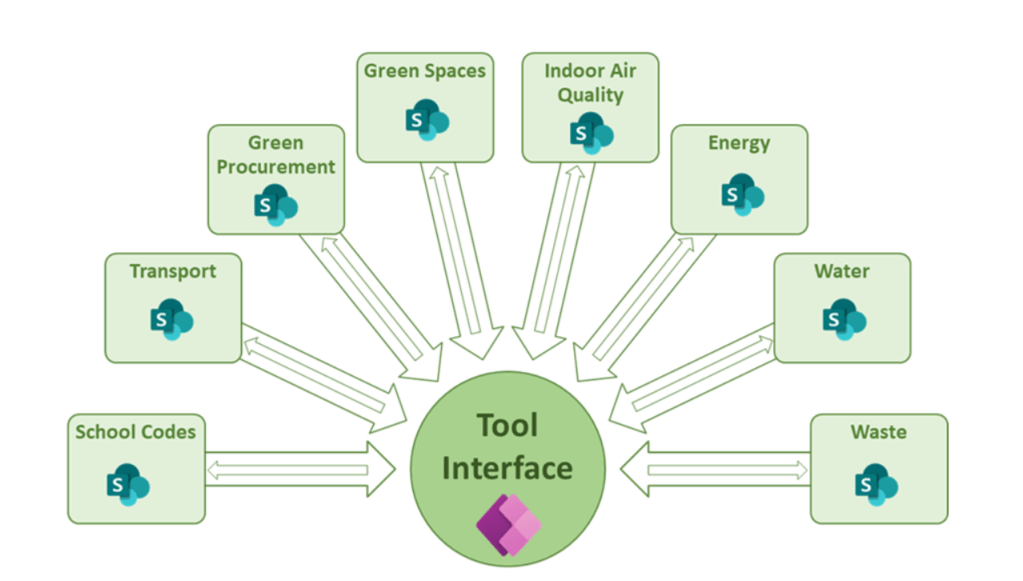
- An Internet of Things (IoT) ecosystem for monitoring indoor air quality, environmental conditions and energy consumption.
In addition, the project created interactive animated books and educational games explicitly linked to the ECF4CLIM roadmap. These resources aim to strengthen both the pedagogical and motivational dimensions of sustainability education.
Learning Through Participation
One of the most engaging moments of the Lisbon event was the participatory activity entitled “Changing Things by Changing Things: the CO₂ and Water Market.” This interactive exercise encouraged participants to reflect collectively on sustainability choices, resource use and climate impacts through experiential learning.
The activity illustrated one of the core principles of ECF4CLIM: sustainability competences are developed not only through theoretical instruction but also through participation, collaboration and real-life experiences.
Challenges and Opportunities
The workshop also addressed some of the challenges encountered during the project. These included adapting methodologies to different educational systems, dealing with changing participants over time and managing interdisciplinary collaboration among researchers from diverse backgrounds.
However, the project team emphasised that these challenges also created opportunities for methodological innovation, transnational dialogue and collective learning. ECF4CLIM developed adaptive strategies and iterative processes that strengthened the project’s capacity to respond to diverse educational realities.
Importantly, the project demonstrated that even relatively small institutional changes — such as introducing new courses, modifying procedures or improving collaboration structures — can contribute significantly to sustainability transitions within educational organisations.
Towards transformation through education
By combining participatory processes, practical interventions, digital tools and a broader understanding of sustainability competences, ECF4CLIM offers a valuable framework for supporting educational transformation across Europe.
The Lisbon event demonstrated not only the achievements of the project but also the growing interest among educators and researchers in developing more participatory, systemic and action-oriented approaches to sustainability education.
Ana Prades is a Senior Scientist at the Spanish Public Research Organisations (OPI) and Head of the Centre for Socio-technical Research (CISOT-CIEMAT) in Barcelona.
Yolanda Lechón is a Research Professor at the Energy Systems Analysis Unit of the Centro de Investigaciones Energéticas, Medioambientales y Tecnológicas (CIEMAT), under the Spanish Ministry of Science and Innovation.


Excelent contribution! Congratulations to everyone involved in this project!
GostarGostar