By: Marco Allegra
On November 8-10, 2023, ICS-ULisboa will host the 3rd edition of the Lisbon Early-Career Workshop in Urban Studies, which follows the editions of 2021 and 2022 – Luisa Rossini wrote a post on the 2022 edition. The Workshop is organised by the Urban Transitions Hub (UTH, an ICS-based horizontal and informal group of some fifteen-twenty scholars affiliated to various academic institutions).
As the UTH chair(although I shouldn’t be saying this myself) I can say that the first two editions of the workshop (one online and one in presence) have been very successful success, and the third edition promises to be even better.
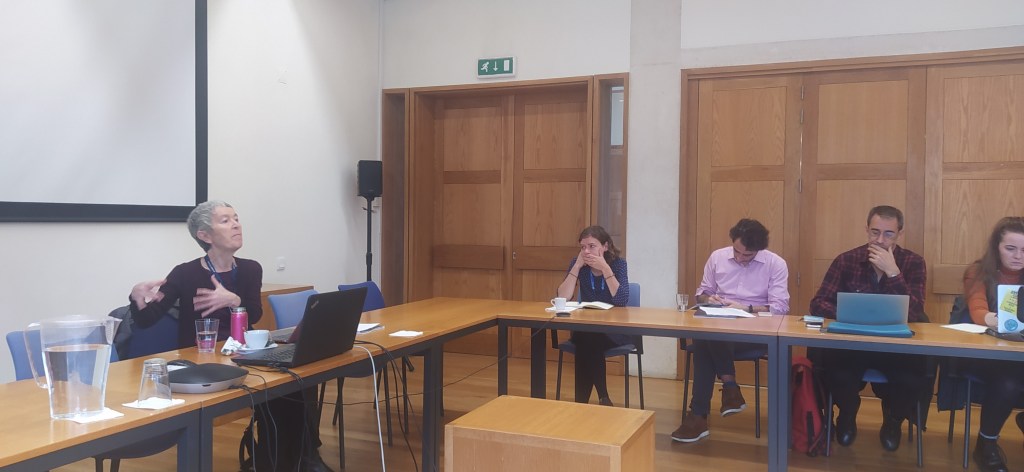
The first two editions have brought together about 45 young scholars from a broad range of countries (14 EU, and 12 non-EU, to be precise) – since the 2023 edition (30 participants from 10 EU and 9 non-EU countries) seems to confirm the cosmopolitan nature of the Workshop audience (due to that I am writing this article in English).
The workshop is organised by UTH and the Young Academics Network of AESOP (Association of European Schools of Planning), and covers its costs through participants’ fees (€200 for the 2023 editions); this year, however, the generous support from the research group SHIFT and the project UrbanoScenes (FCT grant PTDC/GES-URB/1053/2021) has allowed us to offer four full bursaries and two fee waivers. In the past editions we have hosted interesting keynotes (this year we’ll have Michele Lancione and Stephanie Wakefield), very productive sessions, and even had quite a bit of fun. More importantly, the participants seem to have enjoyed the Workshop greatly.
But apart from my boasting, I think that what is interesting here is that the Workshop is only the most visible example of UTH’s activities in the field of peer learning and mentoring – indeed, it would not be an exaggeration to say that the UTH has found in that field its core business.
In the last few years, the group’s stable activities have included the monthly UTH reading group, which has animated an interesting conversation between members and produced several interesting spin offs (e.g. this roundtable on “conflicting imaginaries in East Lisbon” published by the journal Mediapolis, which I presented in an older post on this blog); and several rounds of horizontal peer review of applications, which have contributed to bring in several projects (e.g. Urbanoscenes, LOGO) as well as individual positions (e.g. eight CEEC contracts in five editions of the call).
What links together these different activities – and the Workshop?
The way I see it, the common denominator is in a set of principles that have emerged over time in the UTH group – and first and foremost, the idea that all UTH’s projects should bring a tangible benefit to the participants, and the principle of peer learning and horizontality as a guideline for structuring their interaction.
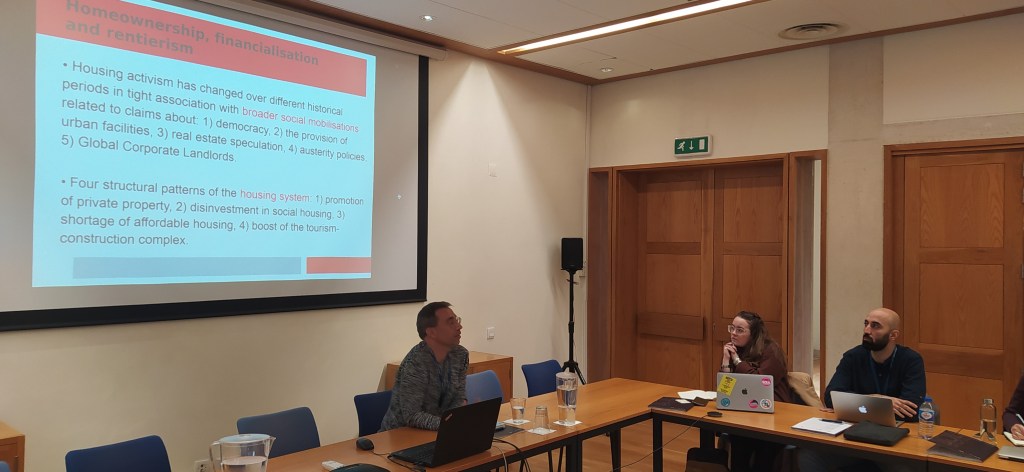
How is this attitude reflected in the organisation of the Workshop?
I think that the Workshop’s basic concept comes from a thought that has probably crossed your mind as well as ours, i.e. that life as an early-career scholar is quite hard. This is a though and complicate line of work, and there are just not many chances to get a helping hand in the development of your own research project: good, dedicated mentoring is hard to come by in many institutions, and conferences are often a chaotic sequence of panel sessions, each one reshuffling the audience of participants and resetting the discussion.
From the very start, the UTH workshop tried to provide an alternative model, i.e. one based on good mentoring and the creation (within logistical and time constraints of a workshop of three days) of some sort of intimacy between participants.
This approach is reflected in the organisation of the workshop in many ways. We ask for example all participants to provide a short text (a short paper or a long abstract, depending on the way you look at it) early on. This allows us to create thematic groups and, importantly, to provide a feedback before the start of the workshop. In Lisbon, each participant is assigned to a thematic group that works together for the whole duration of the workshop. Each group is chaired by one or more UTH mentors, and each participant acts as discussant for one of the texts presented in the panel.
After a first online edition in 2021, last year’s event added to the program a few other important elements, such as, first and foremost, the possibility of actually meeting each other in Lisbon – and using the chance to, for example, add social events to the mix. We have also added a “Lisbon walking tour” to familiarise what is a very cosmopolitan crowd with the recent history of the city. This year, beside the keynote lectures, the program will also include a session on “academic survival” chaired by Abel Polese.
This model, as we practise it, provides different advantages: it creates a more intimate working environment and a group dynamic between organisers, participants and keynote speakers (vs. the typical feeling of being lost in big events); it gives quite a lot of time to participants to present their work (vs. the limited time usually available in conference panels); and it helps developing themes in a more consistent and productive fashion (vs. resetting it after each session).
This model seems to be well-liked by organisers and participants alike – and indeed past editions have already originated some meaningful form of networking and among participants and organisers.
Marco Allegra (Laurea, International relations, University of Torino; MA Near and Middle Eastern Studies, SOAS – University of London; PhD Political Science, University of Torino) is a Principal Investigator at ICS-ULisboa, where he chairs the Urban Transition Hub. His area of expertise includes Middle East politics, planning theory and urban studies; his current research activity focuses on local housing policy and housing movements.
 Blogue SHIFT